
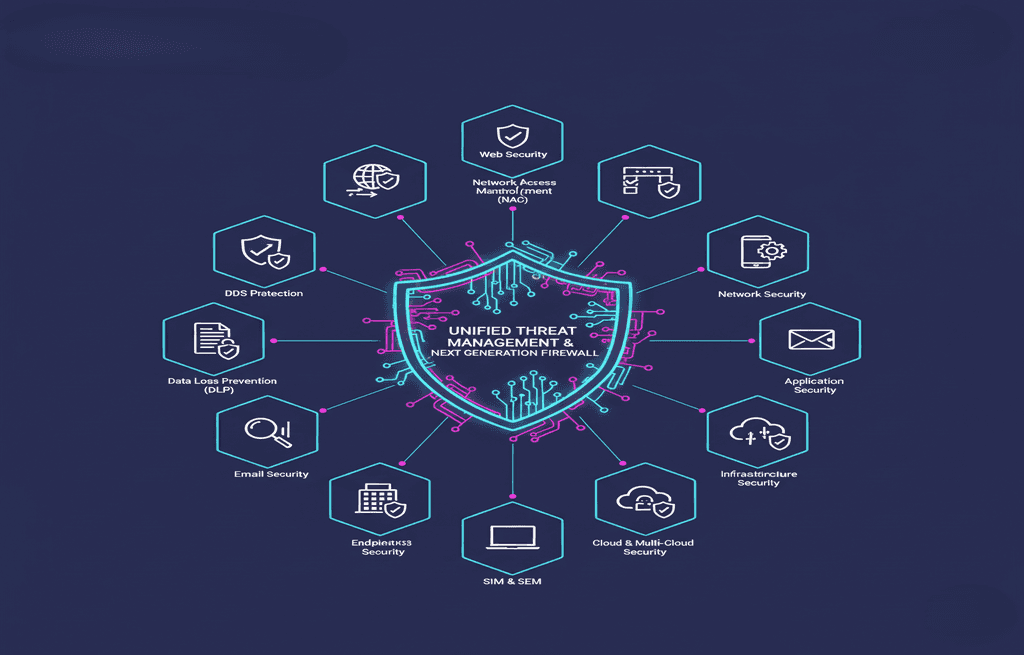
Endpoint Security
Endpoint security is the practice of securing peripheral devices or entry points for end user devices such as desktop computers, laptops, and mobile devices from exploitation by malicious actors and campaigns. Endpoint security systems protect these endpoints on the network or in the cloud from cybersecurity threats. Endpoint security systems have evolved from traditional antivirus software to provide comprehensive protection from sophisticated malware and sophisticated zero-day threats. As the scale and complexity of cyber security threats steadily increases, the need for more advanced security solutions for end devices is growing. Existing endpoint security systems are designed to quickly detect, analyze, block, and contain ongoing attacks. To do this, they need to collaborate with each other and with other security technologies to give administrators visibility into advanced threats to speed up response times for detection and remediation.
Infrastructure Security
Applied to enterprise IT environments, it is the process of protecting the underlying network infrastructure by installing preventive measures to deny unauthorized access, modification, deletion and theft of resources and data. These security measures can include access control, application security, firewalls, virtual private networks (VPNs), behavioral analytics, intrusion prevention systems, and wireless networking.
Cloud & Multi-Cloud Security
Cloud computing security is the protection of data stored online across cloud computing platforms from theft, leakage and deletion. Ways to provide security for cloud computing include firewalls, penetration testing, virtual private networks (VPNs), and avoiding direct and public Internet access.
Application Security
Application security is the process of developing, adding, and testing security features within applications to seal vulnerabilities against threats such as unauthorized access and unauthorized modification.
Network Security
We set of rules and settings designed to protect the integrity, confidentiality, and accessibility of computer networks and data using software and hardware technologies. Every organization, regardless of size, industry, or infrastructure, needs the degree to which their networks are secured to protect them from the ever-increasing landscape of cyber threats in today’s world.
Email Security
We apply various procedures and techniques to protect email accounts and message content against unauthorized access, loss, or disruption. Email is often used to spread malware, spam, and phishing attacks. Attackers use phishing messages to lure recipients into giving up sensitive information, opening attachments, or clicking on hyperlinks that install malware on the victim’s device. Email is also a common entry point for attackers looking to gain a foothold in an enterprise network and obtain valuable and important data.
Security Information Management (SIM) and Security Event Management (SEM)
The combination of Security Information Management (SIM) and Security Event Management (SEM) provides real-time monitoring and analysis of events, as well as tracking and recording of security data for compliance or audit purposes. SIEM is a security solution that helps organizations identify potential security threats and vulnerabilities before they have a chance to disrupt business. It highlights deviations in user behavior and uses artificial intelligence to automate many manual processes associated with threat detection and incident response and has become a staple in modern security operations centers. (SOCs) for Security and Compliance Management use cases. Over the years, SIEM has matured into more than just a records management tool. Today SIEM offers advanced analytics of user behavior and the overall corporate entity thanks to the power of artificial intelligence and machine learning. It is a highly efficient data coordination system for managing ever-evolving threats as well as regulatory compliance and reporting.
Mobile Device Management (MDM)
It is Protecting both data backup as well as data encryption.
Data backup ensures that users have the data they need to conduct business even in the event of data corruption or loss. A copy of all data is taken periodically and regularly and stored in special repositories using the latest technologies that ensure that all data is available in case of loss.
Encryption in cybersecurity is the conversion of data from a readable format to an encrypted format, as the encrypted data can only be read or processed after it has been decrypted. use for harmful purposes.
Data Loss Prevention (DLP)
We prevent data loss and leakage, as well as preventing the unlawful transfer of data outside organizational boundaries. Data loss prevention is the practice of detecting and subsequently preventing data breaches, intrusions or unwanted destruction of sensitive data, resulting in data protection and security and compliance with regulations.
Unified Threat Management & Next Generation Firewall
Unified Threat Management is an information security term that refers to a single security solution, usually a single security device that provides multiple security functions at a single point on the network. UTM usually includes functions such as antivirus, anti-spyware, anti-spam, network firewall, intrusion detection and prevention, content filtering, and leak prevention. Some units also provide services such as remote routing, network address translation (NAT), and virtual private network (VPN) support. The main advantage of this solution is simplicity, so organizations that have multiple security vendors with each system sourced from a separate vendor can now unify all their security systems under one umbrella, run through a single console and supported by a single information security team.
Network Access Control (NAC)
With organizations now having to account for the explosive growth of mobile devices accessing their networks and the security risks that those devices bring, it is critical to have the tools that provide visibility, control of network access, and compliance capabilities required to enhance the infrastructure to secure the network. Network access rationing can deny incompatible devices access to the network, put them in an isolated area, or give them only restricted access to certain resources, thus preventing unsecured nodes from infecting the network.
DDS Protection
DDoS attacks are often referred to as distributed denial of service (DDoS) attacks. Performers of this type of attack take advantage of specific capacity limits that apply to any network resources such as the infrastructure that enables a company’s website. A DDoS attack will send multiple requests to the attacked Internet resource to bypass the website’s ability to handle multiple requests, preventing the website from functioning properly.
Web Security
Internet security refers to protecting networks and computer systems from damage or theft of software, hardware, or data. It includes protecting computer systems from misdirecting or disrupting services designed to provide them.
Securing the Internet is synonymous with cybersecurity and also covers securing websites and protecting them from attacks, securing cloud computing and applications running on the Internet, as well as protecting a virtual private network (VPN).
Application Firewall protects Internet-based applications (WAF) from a variety of attacks such as cross-site scripting (XSS), SQL injection, and cookie poisoning, these attacks are the main cause of breaches, they are the gateway to valuable and important data. With the right WAF in place, you can prevent a host of attacks aimed at hacking that data by putting your systems at risk.